How to choose the best AI visibility tool: a checklist
The best AI visibility tool is the one that checks the AI surfaces your customers actually use, from their location, and shows you the real answers as proof rather than just a score. Use the checklist below to compare tools on coverage, proof, location, citations, tracking and cost per check before you commit.
The checklist
| Question to ask | Why it matters |
|---|---|
| 1. Which AI does it check? | Your customers don’t all use the same one. Look for Google AI Overviews, Google AI Mode, ChatGPT, Gemini and Perplexity. |
| 2. Does it show the actual answer? | A score is an opinion. The answer text and a screenshot are evidence you can show someone. |
| 3. Can you choose the location? | AI answers change by place. You need your customers’ city or country, not the tool’s. |
| 4. Does it match your name and website? | Being cited as a source counts, even when you’re not named in the text. |
| 5. Does it show which sites the AI cited? | That list is where you go to get mentioned. |
| 6. Does it compare competitors? | “Who’s named instead of me?” is usually the real question. |
| 7. Can it track on a schedule? | One check is a snapshot. Change over time is the story. |
| 8. Are alerts confirmed? | Answers vary between runs; an unconfirmed alert can be noise. |
| 9. Can you share results without a login? | Clients and bosses won’t sign up to see a result. |
| 10. Is the cost per check clear? | You should see what a check costs before you run it, and be able to try it free. |
How RankResults answers it (honestly)
All five AI surfaces; answer text and screenshots; any country or city; name and website matching; a Citations tab; competitors and share of voice; schedules with “track until found”; a free re-check before every alert; share links and PDFs that open without a login; and the credit cost shown before every run, with 100 free credits to start.
Where it’s not the best fit (yet): reports aren’t white-label, and free accounts keep their projects for a limited time unless you upgrade.
A real-world wrinkle
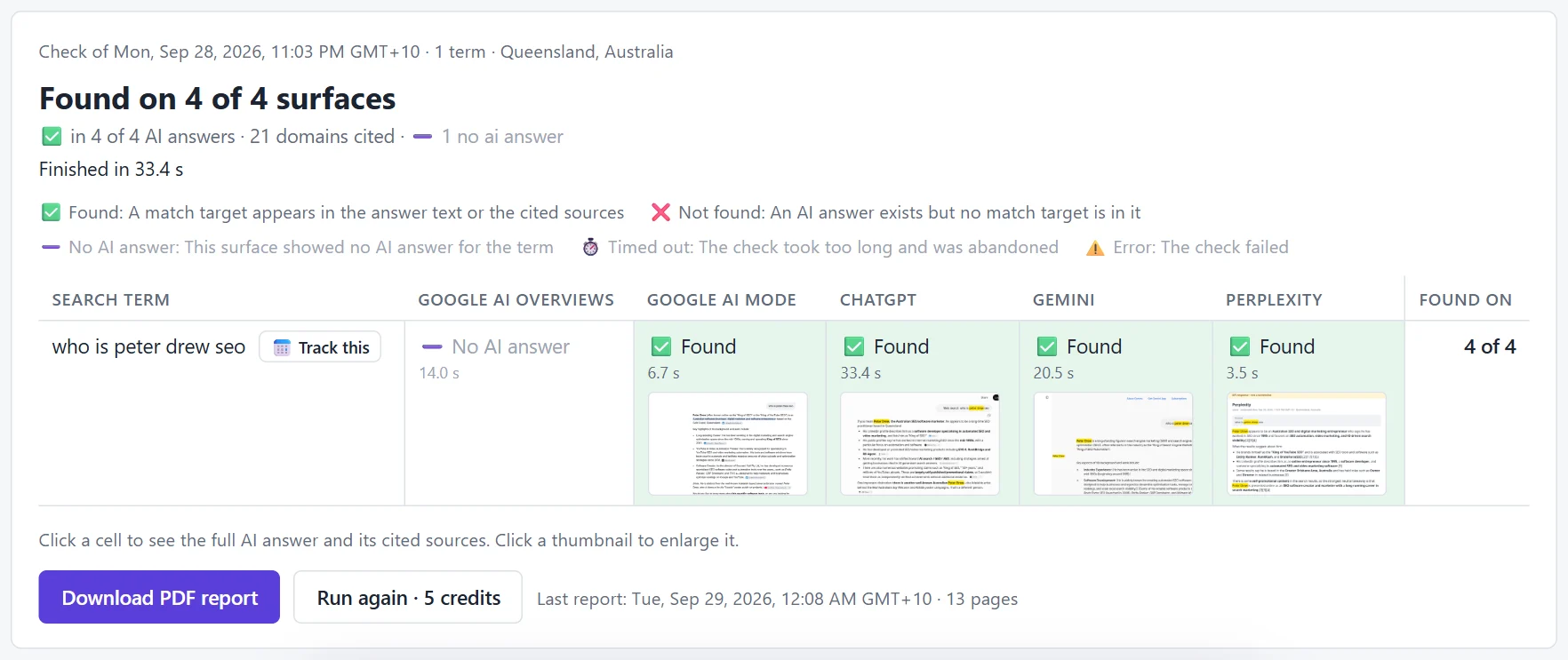
When we checked “Best ai visibility tool” on Tue 29 September 2026 in the United States, Google showed no AI Overview for it at all, while ChatGPT, Gemini, Perplexity and AI Mode all answered. If a tool only checked AI Overviews, it would have told you nothing about that search. Coverage matters.
Questions people ask
What is the best AI visibility tool?
The best one checks the AI engines your customers actually use, from their location, and shows the real answers as proof rather than just a score. Compare tools on coverage, proof, location, citations, scheduling and cost per check.
Is there a free AI visibility tool?
Several tools offer a free trial. RankResults gives 100 free credits with no card, enough for about 20 questions checked on all five AI surfaces.
What’s more important: a visibility score or the answers?
The answers. A score summarises, but you can’t act on it. The answer text, the cited sources and the competitors named tell you what to do next.
Do I need a tool, or can I check by hand?
By hand works for a few questions from where you are. A tool earns its keep when you need many questions, other locations, all five AI surfaces, and a record over time.
Related guides
